
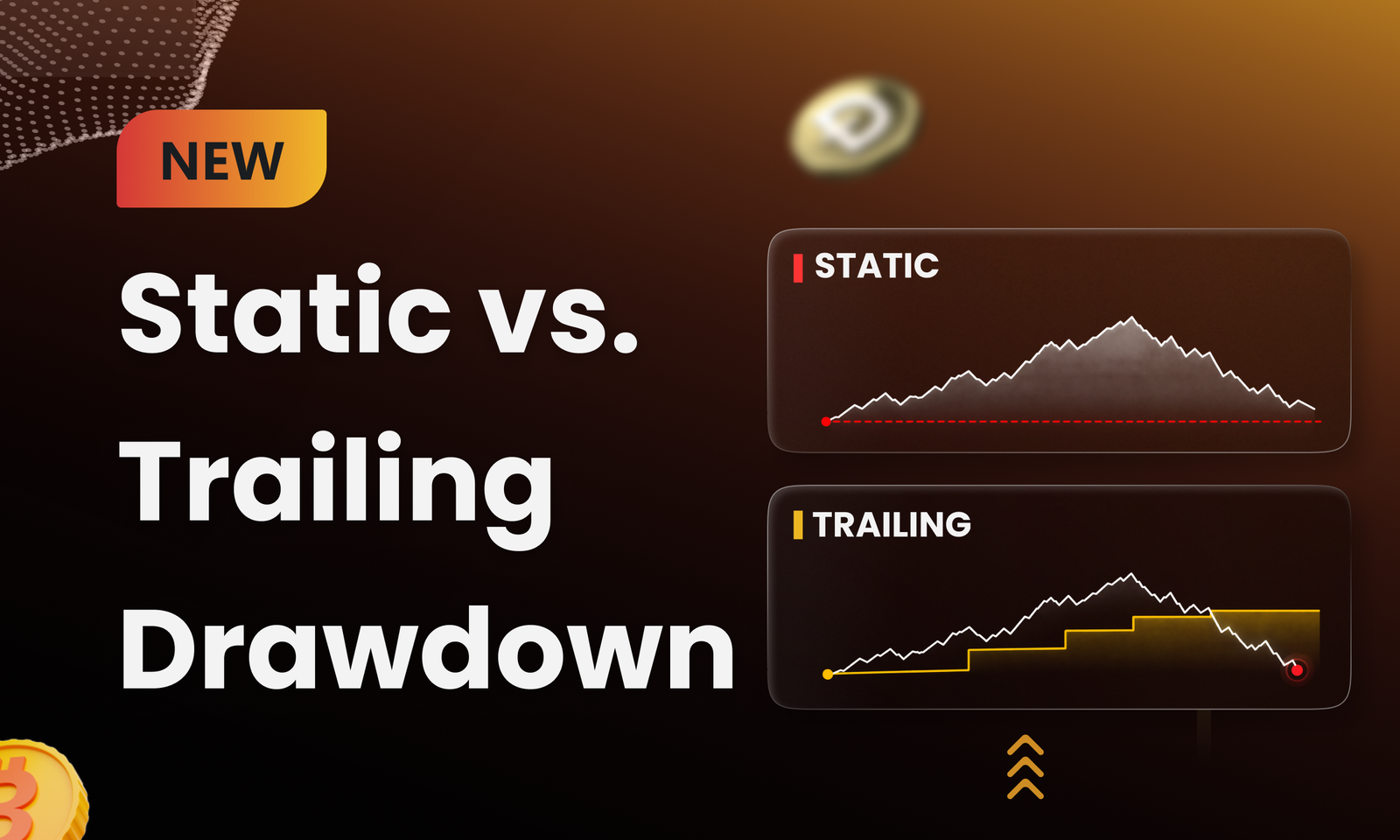
Static vs trailing drawdown is one of the first risk decisions a prop firm operator makes. Drawdown rules are often shown as a percentage of the starting balance, so a 10% rule on a 100,000-unit account means a 10,000-unit allowance. Whatever form you publish, you need to know how the loss line is set and whether it can move. You also need a clear account action after a breach. A drawdown rule configuration helps you settle those questions before the rule reaches a trader.
The difference between static and trailing drawdown becomes much clearer when similar accounts take the same path under both rules. This guide uses a few illustrative scenarios to show where the two outcomes split.
Daily loss works from a separate reference and reset window. If your program uses both controls, the daily loss configuration should make their relationship clear to the trader.
Two terms are used throughout. The floor is the account value at which a drawdown breach is recorded. The high-water mark is the highest reference value the rule has recorded so far.
Think of a static rule as a floor drawn from the account’s starting point. The floor remains there even after the account makes a profit. Its calculation is straightforward:
static floor = initial reference − drawdown allowance
Take an account that starts at 100,000 units with a 10,000-unit drawdown allowance. Its floor is 90,000 units. If the account later reaches 108,000, the floor stays at 90,000. The account has gained more room above the floor, while the floor itself has not moved.
Before you publish the rule, say which value the platform watches. A balance-based rule and an equity-based rule can reach different results. The same applies to fees or an account adjustment: your traders need to know how each item enters the calculation.
Trailing drawdown works from the high-water mark. When that value rises, the floor can rise with it:
trailing floor = high-water mark − drawdown allowance
Using the same 10,000-unit allowance, a high-water mark of 108,000 creates a 98,000 floor. If the account later pulls back, that 98,000 floor stays in place while the trailing rule remains active. This is why an account can be above its static floor and below its trailing floor at the same time.
Trailing rules need a few decisions written in plain language. State which value creates a new high-water mark and when the platform records it.
One common configuration locks the floor at the starting balance. In this example, a $100,000 starting balance and a $10,000 allowance create a $100,000 floor once the high-water mark reaches $110,000. The floor can stay at $100,000 from that point, even if the account makes a later high. Other programs continue to trail. Treat the lock as a rule choice and show traders which behavior applies.
| Account event | Balance | Static floor | Trailing high-water mark | Trailing floor | Result |
|---|---|---|---|---|---|
| Start | $100,000 | $90,000 | $100,000 | $90,000 | Both rules have $10,000 headroom |
| New high | $108,000 | $90,000 | $108,000 | $98,000 | Trailing floor moves upward |
| Pullback | $103,000 | $90,000 | $108,000 | $98,000 | Static headroom is $13,000; trailing headroom is $5,000 |
| Further loss | $97,500 | $90,000 | $108,000 | $98,000 | Static balance is $7,500 above its floor; trailing balance is $500 below its floor |
Use a separate scenario to compare calculation bases. Assume the trailing high-water mark is $108,000 on both bases, so the trailing floor is $98,000. The account has a posted balance of $103,000, while an open position brings its equity down to $97,000. A balance-based rule still sees the account above the floor. An equity-based rule records a breach of $1,000.
Note that an equity-based rule would also record its high-water mark from equity, which can be higher or lower than the balance-based high. The example keeps the two the same so the comparison isolates the effect of the check itself. In your program, use the same basis when the platform records a high-water mark and when it checks a breach, and make that basis visible in the public rule and in the trader’s account view. A timestamp also helps support and operations explain what the system saw at that moment.
Timing can change the result just as much as the calculation basis. This scenario is separate from the table above. Assume the previous daily-close high-water mark is $100,000. During the session, the balance touches $108,000 and returns to $103,000 before the day closes. An intraday rule records the $108,000 high, so its trailing floor is $98,000. A daily-close rule updates its high-water mark from $100,000 to the $103,000 close, so its floor moves from $90,000 to $93,000.
Choose one approach for your program and state it plainly. Name the time zone and data source. Then explain when the day’s numbers become final, so your team and your traders are looking at the same clock.
The choice shapes both your program’s risk boundary and the trader experience.
| Decision question | Static drawdown | Trailing drawdown |
|---|---|---|
| Program risk after an account gains | The floor stays on the original reference. A profitable account keeps more loss room, so more of its gains can be given back before a breach. | The floor rises with the high-water mark while the rule is active, so less of the gain can be given back before a breach. |
| Loss room for the trader after a new high | The trader keeps the same loss capacity after a new high. | The trader has less room after a new high and must protect gains as the account climbs. |
| Effect on challenge progression | With the same target and allowance, the fixed floor gives more room after a high and can lead to fewer drawdown-triggered resets. | With the same target and allowance, the rising floor gives less room after a high and can lead to more drawdown-triggered resets. |
With the same target, allowance, and other controls, a trailing rule can create more drawdown triggers after an account reaches new highs. Actual challenge pass rates also depend on the daily-loss rule. Update frequency and any lock mechanism matter too. Test representative account paths or historical data before making the rule part of a trader promise.
As a starting point: if your priority is a more forgiving trader experience and fewer drawdown-triggered resets, a static rule is the natural fit. If your priority is limiting how much of an account’s gains can be given back, a trailing rule fits better, ideally with a lock so traders are not squeezed indefinitely. Many programs apply different rules by stage, for example a looser rule in the challenge and a tighter one on funded accounts. Treat these as a starting point for your own testing, not a fixed recommendation.
When an account crosses a floor, your program needs an account action the trader can understand. The following are configurable operating choices. Put the selected action in the program terms and show it in the account state.
Hard breach suits a program that treats a floor crossing as the end of the current challenge or account stage. The stage ends immediately and further trading stops. Show the trader which floor and calculation basis produced the result, then explain the next step.
Where a data or execution issue needs a manual check, trading hold and review gives your team time to confirm the outcome. Trading stays restricted while the review is open, and the trader should know what is being checked and when to expect an update.
Stage-specific handling works when challenge and funded accounts follow different risk treatment. Assign the action to the current phase, then show the trader the applicable rule and resulting account status.
The chosen response should use the same rule version and calculation basis that produced the result. That gives your team and the trader a direct way to retrace the decision.
The real-time rule enforcement log should keep the event that led to the decision and the rule version in force. It gives your team a clear starting point for a breach review.
For a drawdown review, start with the rule version your program applied. Keep the observed reference and resulting floor with the event input and time that set them. This gives your team enough to explain the floor without turning every review into a full audit.
Static and trailing drawdown become much easier to explain when the floor and update method sit alongside the evidence for each decision.
days left to apply
Static vs Trailing Drawdown: A Guide for Prop Firm Operators Static vs

One-Step vs Two-Step Prop Challenges: A Guide for Prop Firm Operators If

If you are comparing a prop trading platform vs brokerage platform, it

White Label vs In-House Prop Trading Platform: Costs and Trade-Offs The choice

How to Choose a Prop Trading Technology Provider Choosing a prop trading

Tell us about your project and we’ll schedule a demo with our product specialists.
By submitting, you agree to our privacy policy and consent to being contacted about opportunities.